A look at Master Shahram Nazeri’s performance at the International Conference on the Feyli Kurdish Genocide in Erbil.
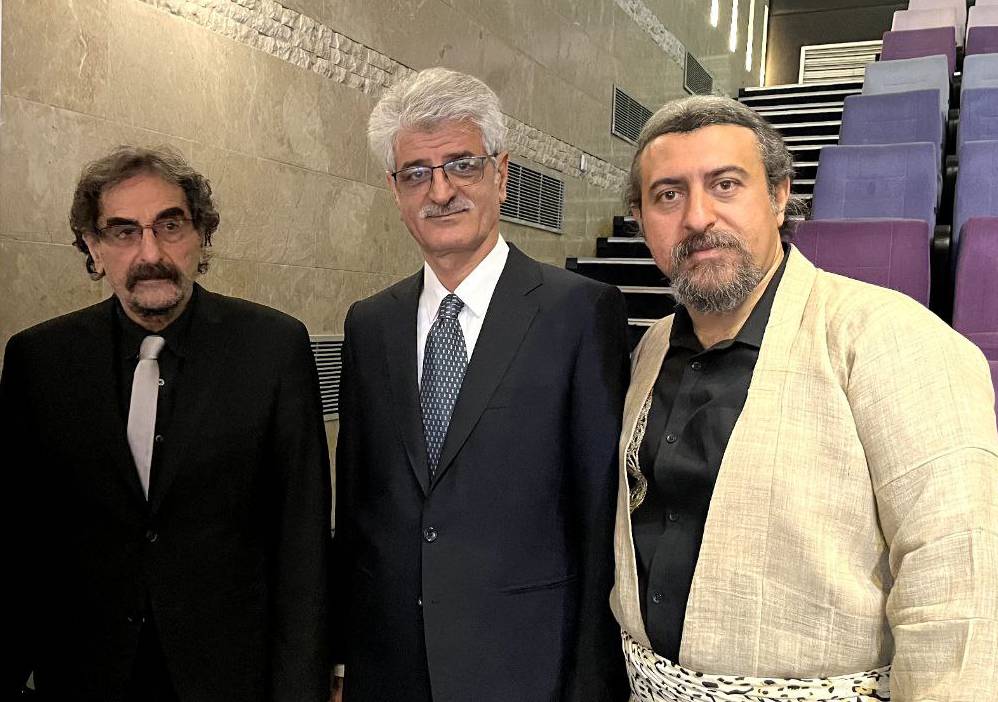
Hamidreza Atefi, journalist and board member of the Association of Music Researchers, reflected on Nazeri’s performance in his note “A Pain Equal to a Thousand Remedies.”
According to Soroush News, the international academic conference marking the 43rd anniversary of the genocide of the Kurdish people—titled The Genocide of the Feyli Kurds of Iraq—was held with the participation and speeches of prominent political, academic, and cultural figures from the Kurdistan Region and various countries. The event was organized by the Universities of Salahaddin-Erbil, Duhok, and Soran, and featured a performance by Shahram Nazeri, the “Knight of Iranian Song,” accompanied by the Sanyar Music Ensemble led by Farid Elhami. It took place from May 2 to May 5, 2023 (12–15 Ordibehesht 1402) at the Saad Abdullah Hall in Erbil, the capital of the Kurdistan Region of Iraq.
The conference brought together representatives of various institutions, university professors, political and cultural officials, as well as senior Kurdish and non-Kurdish figures, who spoke about this tragic catastrophe. Each speaker condemned the brutal genocide of the 1980s, which resulted in the destruction of hundreds of Kurdish villages and the massacre of tens of thousands of innocent people.
Holding such international programs has profound and lasting impacts in raising global awareness and public consciousness, serving as one of the best and most civilized methods to prevent the recurrence of such atrocities.
Undoubtedly, only through cultural growth, intellectual advancement, and the promotion of the humanities can humanity hope for a bright future filled with peace and prosperity. Cultural authorities of the Kurdistan Region have rightly recognized that no power surpasses the power of culture, which serves as a fundamental infrastructure for growth and development across all key pillars of governance, including economy, politics, and other social sciences.

During this valuable conference, another significant and noteworthy event took place that deserves reflection: the performance of Kurdish music by the Sanyar Ensemble, led by Farid Elhami, featuring the unparalleled voice of Master Shahram Nazeri.
Without doubt, Shahram Nazeri is one of the enduring figures of Kurdish music. Compared to all renowned Kurdish singers in Iran, Iraq, Syria, and Turkey, he possesses unique qualities that make him truly exceptional.
His mastery of Iranian traditional (urban) music, his deep study and knowledge of Persian poetry and literature, his collaborations with great Iranian musicians, and his creation of timeless works and songs that have left profound impacts nationally and internationally, have elevated Nazeri to a lofty peak of artistic excellence. These qualities, like an unmatched spring, have nourished the delicate roots of the ancient Kurdish nation and placed them high in the sky of Kurdish culture and art.
Nazeri has created brilliant and outstanding works in both Kurdish and Persian, which is the most remarkable artistic trait of this distinguished artist of our time. His refined and creative nature in composition, melody-making, and even instrumental performance is another defining feature of this celebrated singer.
Beyond these artistic qualities, Nazeri’s artistic persona is comprehensive and all-encompassing. With decades of cultural and social activity, a sharp mind, and a critical temperament, he demonstrates extraordinary skill in blending poetry and music, refining melodies, and arranging compositions with meticulous precision.
The author of these lines has had the privilege of witnessing some of Nazeri’s collaborations with prominent composers firsthand, and is well aware of his precise insights and masterful critiques.
This brief introduction serves to highlight that the selection of the piece “Shur-e Dard” (Painful Ecstasy) for performance at the memorial of the Feyli Kurdish genocide was executed with utmost mastery. According to reports, the musical program of the conference was finalized shortly before the event, and the performance of such a piece—so inherently aligned with the occasion—was truly commendable. In other words, the choice and execution of this piece amounted to a complete masterpiece.
“Shur-e Dard,” composed by Shahram Nazeri based on the Majnuni mode, was arranged years ago by Alireza Feyz Beshipoor and released in the album Avaz-e Asatir (Mythical Songs) in Iran. Interestingly, it had never been performed live in any concert in Iran until this occasion.
The poignant lyrics, written by Seyed Saleh Mahidashti in mourning of a lost loved one, are deeply moving and highly visual. They depict the burning soul of a survivor who, oppressed by tyrants, flees to the wilderness and cries out in exile and longing. The heavenly voice, the sorrowful melody, the beautiful arrangement by Farid Elhami, and the extraordinary performance by Shahram Nazeri penetrated the very core of the audience, casting the Saad Abdullah Hall into meaningful silence. As literary figures would say, the waves of music swept from the teeth to the depths of the soul of the listeners.
The piece “Shur-e Dard” revived the pain of the Kurdish genocide after 35 years in the hearts of every attendee, stirring emotions beyond description.
In another part of the musical program, the Sanyar Ensemble, without Nazeri’s presence, performed mourning music specific to Feyli Kurdish ceremonies. The beautiful poem by Behrouz Taheri, interwoven with the ancient vocal traditions of Hureh and Mor, was executed with such delicacy and mastery that it left the audience breathless.
Archival footage of the Feyli genocide—sourced from the private collection of Kurdish researcher Adalat Omar and edited by Farid Elhami—further illustrated the depth of pain and sorrow for the international audience.
Undoubtedly, this musical performance was a valuable milestone for all organizers of the conference, and gratitude must be extended to every member of the Sanyar Ensemble, its talented and dedicated leader Farid Elhami, and the cultural officials of the program.
Members of the Sanyar Ensemble at the International Conference commemorating the Feyli Kurdish genocide in Iraq:
- Farid Elhami – Ensemble leader, vocalist, and Tanbur player
- Saber Nazargahi – Divan player
- Fernod Elhami – Tanbur player
- Amin Heydari – Oud player
- Ehsan Abdipour – Kamancheh and Sorna player
- Nabil Yousef Sheridavi – Daf player
- Sepehr Zolnoori – Tanbur player
- Saeed Emami – Percussionist
- Ghazaleh Shirazi – Cellist
- Saba Mohammadi – Vocalist
- Servonaz Atefi – Tanbur player
- Diana Moradi – Tanbur player
Reporter: Mohammad Tabandeh-Nasab